
1. Decide what the start session is training
“Starts” can describe several different goals: responding to the gun, settling patiently in the blocks, producing force, clearing the blocks cleanly, or connecting the first steps into acceleration. Choose one or two priorities before the session so every repetition has a clear reason.
Reaction work uses short, focused attempts and consistent measurement. Technical block work may need video and coaching cues. Acceleration work extends farther down the track and usually needs more recovery. Trying to score all of these from one number makes the session less useful.
2. Place the phone safely
Audio-only start beside the blocks
Place the phone or speaker beside the start area, outside the lane and away from hands, feet and the block rail. Use a walk-to-blocks delay so a solo athlete never has to rush into position.
Movement reaction drill
A movement estimate requires the phone to move with the athlete. For a stationary arm-response drill, hold it firmly and drive the hand at the signal. For fuller movement, secure the device appropriately and understand that it measures the phone’s movement, not force from the blocks.
Side-on camera view
Use a stable tripod, frame the complete start area and keep the phone perpendicular to the direction of travel where possible. Higher frame rates can narrow frame-by-frame uncertainty, but camera results remain training estimates.
3. Build a simple, repeatable session
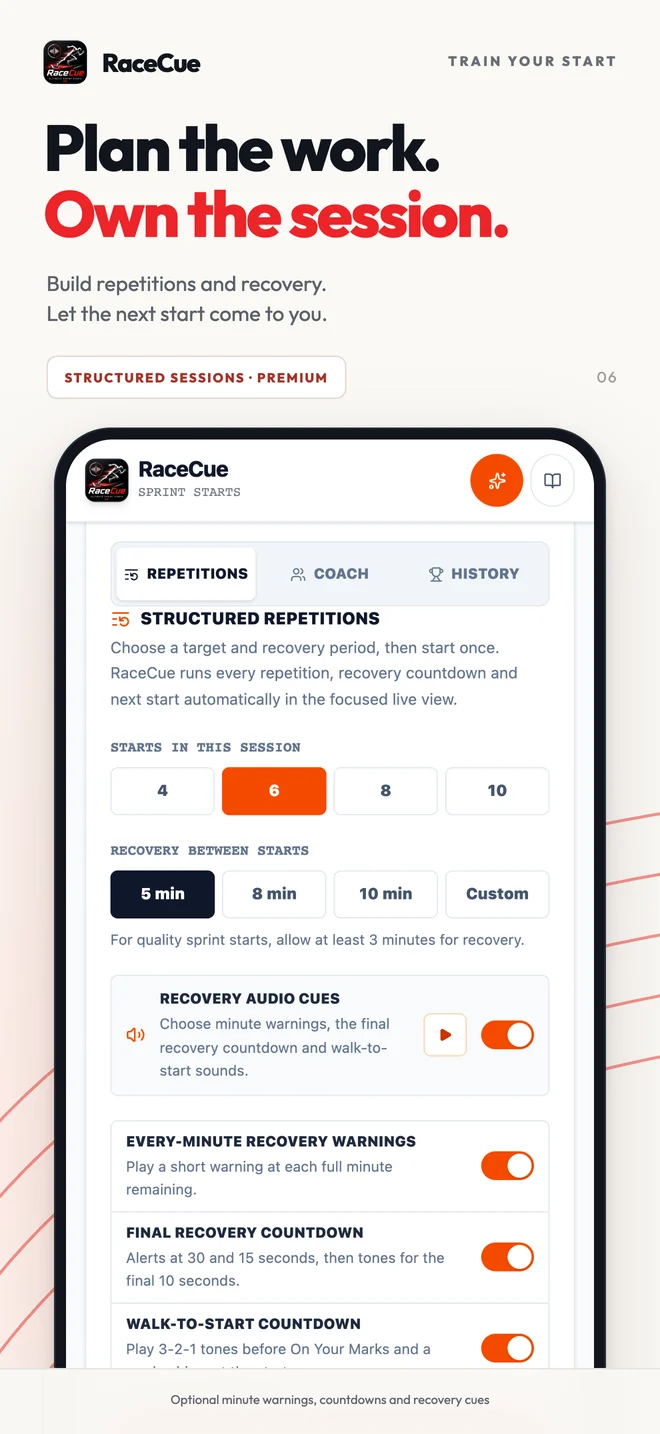
A practical start session can begin with low-intensity rehearsals and progress to a small number of high-quality block starts. The example below is a template, not a universal prescription:
- Complete the normal sprint warm-up and movement preparation.
- Run two or three controlled start-position rehearsals without a maximal sprint.
- Complete four to six focused starts over a distance matched to the goal.
- Allow enough recovery to reproduce the intended quality. For demanding maximal starts, recovery is normally measured in minutes rather than seconds.
- Record one cue or observation after each rep and stop when quality clearly drops.
If positions, concentration or acceleration deteriorate, adding more starts often rehearses the wrong movement. Coaches should adapt repetition count and recovery to the athlete, age, training phase and session goal.
4. Respond to the commands, not a countdown
Use On Your Marks, Set and a start signal in the same order athletes hear in competition. Vary the Set hold within a sensible range. The aim is to remain still and responsive, not to predict when the gun will fire.
Competition-pressure tools can add a stand-up, recall, misfire or quiet track atmosphere. Introduce them after the athlete can execute the basic sequence consistently. Pressure should test concentration without turning every repetition into noise.
World Athletics describes sprint starts around the On Your Marks and Set commands followed by the starting pistol. Its teaching material also treats reaction and reactive movement as part of sprint practice. See the World Athletics 60m sprint teaching page.
5. Review more than reaction time
Reaction is only the beginning of the start. Review whether the athlete stayed patient, moved decisively at the signal, projected from the blocks, coordinated the arms and connected the first steps into acceleration.
- Compare similar repetitions rather than mixing touch, phone movement and camera estimates.
- Use side-on video to review positions, not to manufacture an “official” reaction time.
- Track consistency and false starts alongside the fastest response.
- Keep cues short enough that the athlete can apply them on the next repetition.
6. Keep equipment and athletes safe
Never place a phone where it can be struck by a hand, spike, block or accelerating athlete. Avoid holding the phone during a full sprint unless the drill is explicitly designed and supervised for that use. Test audio at a sensible distance, protect hearing and keep commands clear without excessive volume.
Young athletes should use camera, motion and training features under appropriate parent, guardian or coach supervision. Stop the session if fatigue, pain, weather or track conditions make maximal starts inappropriate.