What does sprint reaction time measure?
In a race, reaction time describes the interval between the start signal and a detected response from the athlete. That sounds simple, but different systems detect different responses. Competition equipment monitors the relationship between the signal and force or movement at the blocks. A phone might detect a touch, movement of the device or visible movement in a video frame.
Those measurements are related, but they are not interchangeable. A 0.18-second screen tap and a 0.18-second camera estimate do not prove the same physical event happened at the same moment.
Official reaction time and a training estimate are different
World Athletics explains that competition false-start systems use sensors connected to the starting signal and blocks, and that a detected reaction below 0.100 seconds is treated as a false start under the applicable rules. RaceCue does not replace that equipment.
Use phone results to compare training performed with the same method, device and placement. Do not publish them as certified block reaction times. The distinction protects athletes from false confidence and makes the training data more useful.
Touch reaction, phone-movement reaction and camera reaction are labelled as training measurements or estimates. RaceCue does not call them official block reaction times.
Train the response, not the ability to guess
If every Set hold is identical, athletes can learn the rhythm and begin moving before they have processed the gun. Random variation removes that countdown. The athlete must remain still, listen and respond.
Do not make the range so extreme that the drill stops resembling the intended environment. Use realistic variation, record false starts and value a clean series over one unusually fast attempt. Occasional recalls or stand-ups can add concentration pressure once the basic drill is stable.
Choose one reaction method for the comparison
Touch reaction
The athlete taps the screen at the signal. It is accessible and easy to repeat, but it primarily measures a hand response to the cue rather than a block start.
Phone-movement reaction
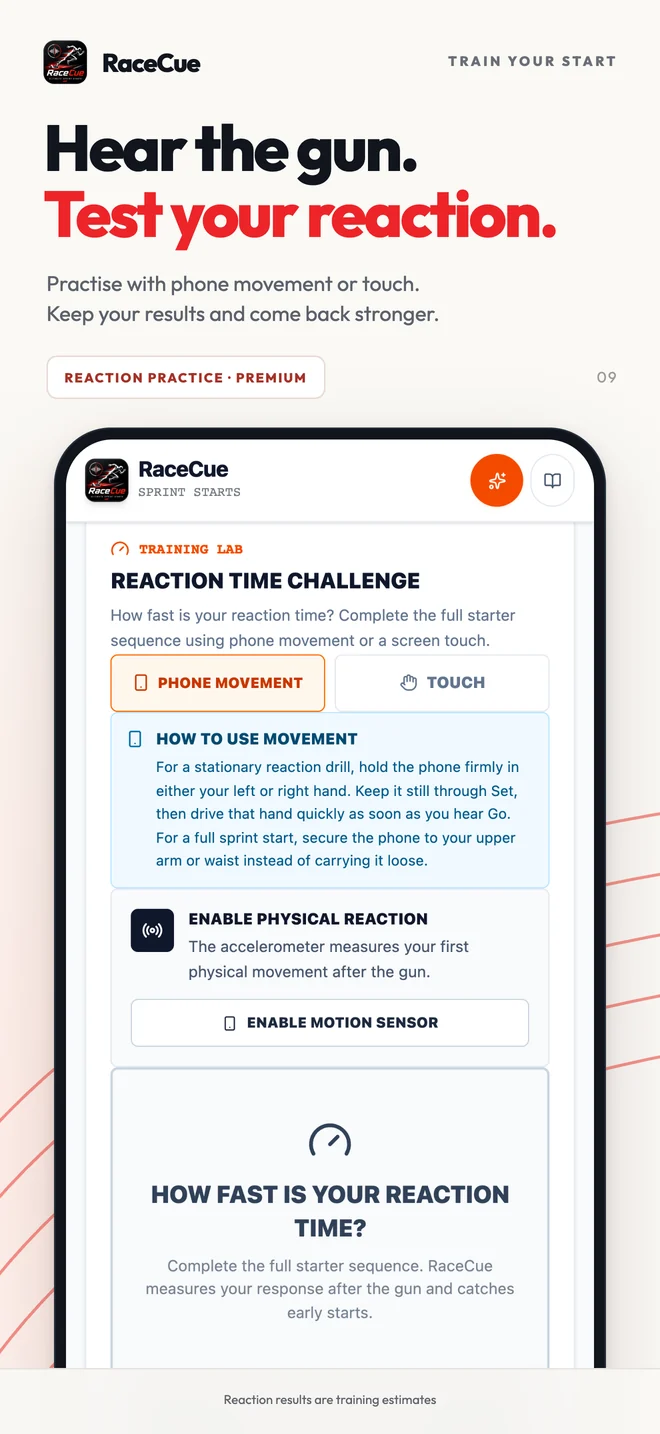
The phone’s motion sensors detect the first meaningful device movement. This can support arm-drive or body-movement drills, but the result depends on where and how the phone is held or secured.
Camera reaction estimate
A mounted camera looks for visible movement after the start. Frame rate, angle, light, clothing and the detection threshold affect the result. Camera review adds context, but it still does not measure force through the blocks.
A simple reaction challenge protocol
- Choose touch, phone movement or camera and keep that method for the full set.
- Use the same phone, placement, hand and body position.
- Complete a small number of familiarisation attempts before recording the set.
- Run five to ten measured attempts with varied Set holds and sufficient reset time.
- Record false starts rather than deleting them.
- Review the median or average, fastest valid result and spread between attempts.
The exact number of attempts should fit the drill and athlete. Stop if concentration or movement quality declines. Reaction practice should not replace technical start training, acceleration work or normal coaching observation.
How to interpret improvement
Look for a cluster of valid results moving in the right direction, not one personal best. Improvement is more convincing when the typical result becomes faster, false starts remain controlled and the first movement still looks technically useful.
Device changes can shift the result. So can sleep, fatigue, warm-up, noise, surface, start position and sensor placement. Note meaningful changes and compare like with like.
A useful reaction result answers, “Was this response faster and more repeatable under the same training setup?” It does not answer, “What would the certified blocks report in a championship?”